
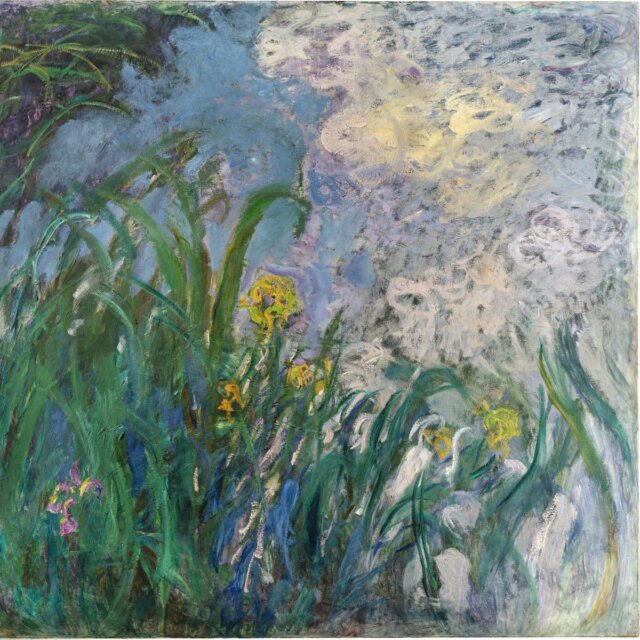
Monet's 'Iris' had never hung in public. After 45 minutes and six bidders, it became the most expensive artwork ever sold at a French auction.
It took six bidders and 45 minutes to part a Parisian family from a painting that the public had never seen. On 22 October, Claude Monet’s Iris sold at Sotheby’s Paris for €50 million ($56.2 million), the highest price ever paid for an artwork at a French auction. The buyer is a private collector in Asia.
The numbers are lopsided. The estimate was €22 to €30 million ($25 million to $35 million), already the highest ever put on a painting consigned at auction in France. The hammer more than doubled the low end. The old French record was Modigliani’s Tête de Caryatide, which made €43.2 million ($48.4 million) at Christie’s Paris in 2010. Iris cleared it by nearly seven million euros. “Tonight, Paris belonged to Monet,” said Thomas Bompard, Sotheby’s France co-head of Modern and Contemporary art.
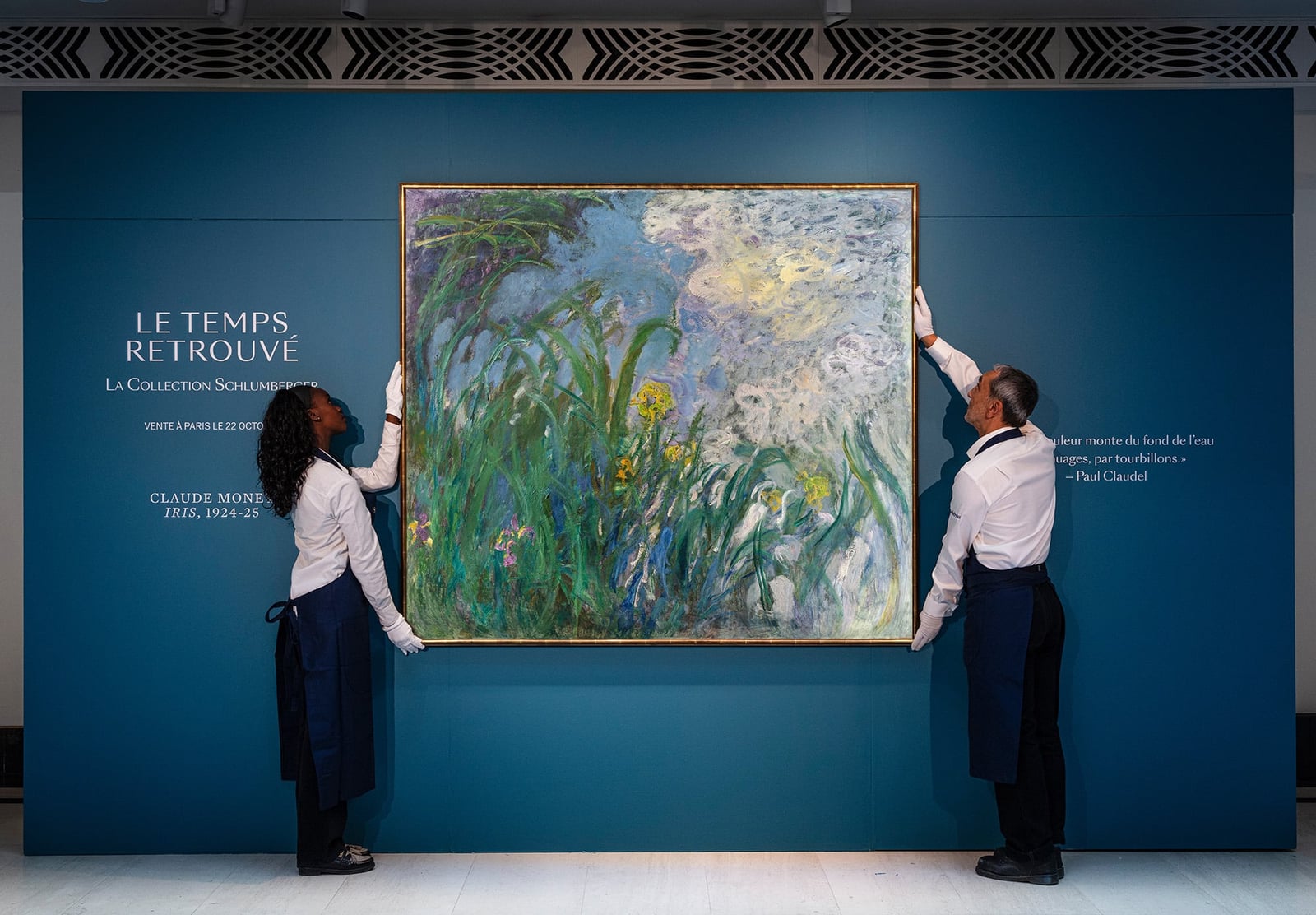
A square the size of a doorway
Painted in 1924–25, Iris is a monumental square, nearly six feet across, and it has never been exhibited publicly. It comes from Monet’s last years at Giverny, when his eyesight was failing and some critics read his canvases as the work of a master losing control. The flowers and their reflections bleed into each other, and the scale is built to pull you in. Marianne Mathieu, a former curator at the Musée Marmottan Monet and a leading expert on the painter, described the intent this way: “He painted a fragment of reality to give an idea of the immensity of the world.”
Water lilies get the fame, but the iris was Monet’s favourite flower. He painted it in around 20 canvases across two stints, beginning when the First World War sent him back to his garden. Mathieu calls this one an example of the ultimate work of Monet, an attempt “to give a new definition of what painting must be.” Later, the Abstract Expressionists would echo the immersive scale.
The price history shows how far this one outran its peers. According to the Artnet Price Database, the auction record for an iris-themed Monet was £10.8 million (roughly $24 million today), set at Christie’s London in 2015. The best price for a late work was €3.2 million (roughly $7.4 million today), paid for Iris Jaunes at Artcurial in Paris in 2007.
The woman, the dealer and the townhouse
The painting belonged to the Schlumberger collection, assembled by Jeane Schlumberger with the Parisian gallerist Katia Granoff. It was built over five decades from the 1950s and hung in the family’s private townhouse. Schlumberger collected only French and 19th-century artists, which was an unusual position. Granoff preferred contemporary artists she could meet and champion.
In 1956, Granoff, a Russian émigré backed by the Schlumberger industrial fortune, bought the studio holdings Monet had left to his son Michel. That included a clutch of late Giverny paintings that many had written off as messy. Granoff saw radical modernity in them. History has sided with her.
Bompard’s portrait of the collector is the best line of the week: “Jeane Schlumberger was a bourgeoise grand dame living on the Left Bank, but she was quite wild at heart.”
What else came out of the house
The evening was not a one-painting show. Of 28 works, Iris was one of three Monets. Saule Pleureur (1918–19), a fiery view of the weeping willow at the end of his lily pond, made €9.6 million ($10.7 million). La Maison à Travers les Roses (1925–26) fetched €2.5 million ($2.8 million). Both landed within estimate. La Seine à Vernon, Arbres (1894) made €4.2 million ($4.7 million), more than doubling its high estimate.
Three early Cézannes never reached the open market. The town of Aix-en-Provence and the French Ministry of Culture pre-empted La Ferme, Arbres au Bord de la Rivière and Ciel Entre les Arbres. They were painted between 1862 and 1864 as part of a mural at the Jas de Bouffan, the Cézanne family home. They are now designated national treasures, and the Musée Granet will acquire them.
Bonnard and Moreau both got auction records for France. Bonnard’s La Cueillette des Prunes (c. 1899) made €2.5 million ($2.8 million), and Moreau’s Rêve d’Orient (1881) made €1.4 million ($1.6 million). Camille Claudel’s La Valse (1895), the version with more flesh and less drapery, sold for €832,000 ($933,710) against an estimate of €400,000 to €600,000.
The total came to €74.4 million ($83.7 million), the most valuable fine art collection ever sold at Sotheby’s Paris. Some 74 percent of the works beat their estimates.
What it tells you about the top end
Three things stand out. First, freshness is currency. A painting with no exhibition history, from a family that kept it at home for decades, drew a 45-minute fight, while the more familiar Monets in the same sale stayed near their estimates. Second, the money was global: a Paris sale, a French record, and a winning bid from Asia. Third, a strong provenance story still moves the market. The Schlumberger name, a dealer who bet on late Monet when others didn’t, and a collector with a wild streak all appear in the sale’s pitch, and the room paid for them.
Meanwhile the state came shopping too, and took its Cézannes at home. The full account of the sale is at Artnet News.
Via Artnet News


