
The fourth Tambour Convergence swaps gold and diamonds for hardened steel, polished by hand to a shine that is meant to survive real life.
A mirror-polished steel watch looks flawless on day one and has a few opinions by day ten. Louis Vuitton’s new Tambour Convergence Mirror Steel is built to keep those opinions to itself.
Reference W9ST11 is the fourth entry in the Tambour Convergence line, the youngest collection at the House. It launched in 2025 as the first guichet watch conceived entirely at La Fabrique du Temps Louis Vuitton. The first three editions put decoration up front: polished rose gold, platinum set with snow-set diamonds, and rose gold with exterior guilloché. This one puts the case material in the spotlight, and the case is the story.
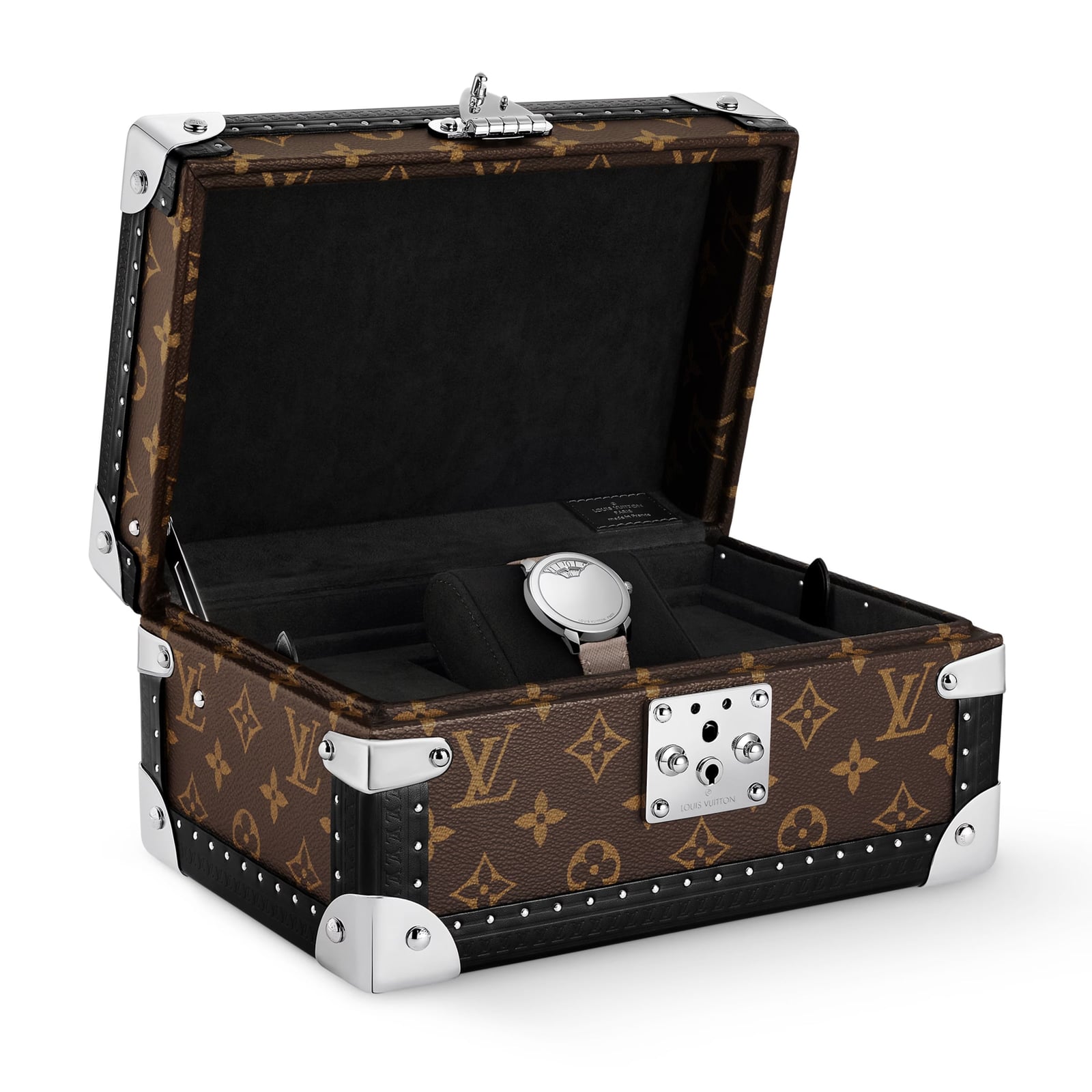
A hard shine
The steel is proprietary and patented. A treatment raises its surface hardness by nearly six times, to 1130 Vickers. Louis Vuitton says that is only slightly below high-tech ceramic. The practical effect is that the small scratches that show up on an ordinary polished watch blend into the shine instead of announcing themselves.
The grade matters as much as the hardening. It is a stainless steel also used in medical implants, with very few impurities even at microscopic level. That purity is what lets the metal take such a high polish and keep it far longer than most polished watches manage.
It is not an easy material to work. The casemakers at La Fabrique des Boîtiers needed up to three times as long to finish a Mirror Steel case as they do for the rose-gold version. They also had to learn how hardened steel responds under the polishing tool, working a fine line between excess and restraint. The finish is entirely by hand. Sandblasted accents sit inside the hollowed lugs and along the arcs and circles that outline the time display, so the mirror surfaces have something matte to play against.
Time through a window
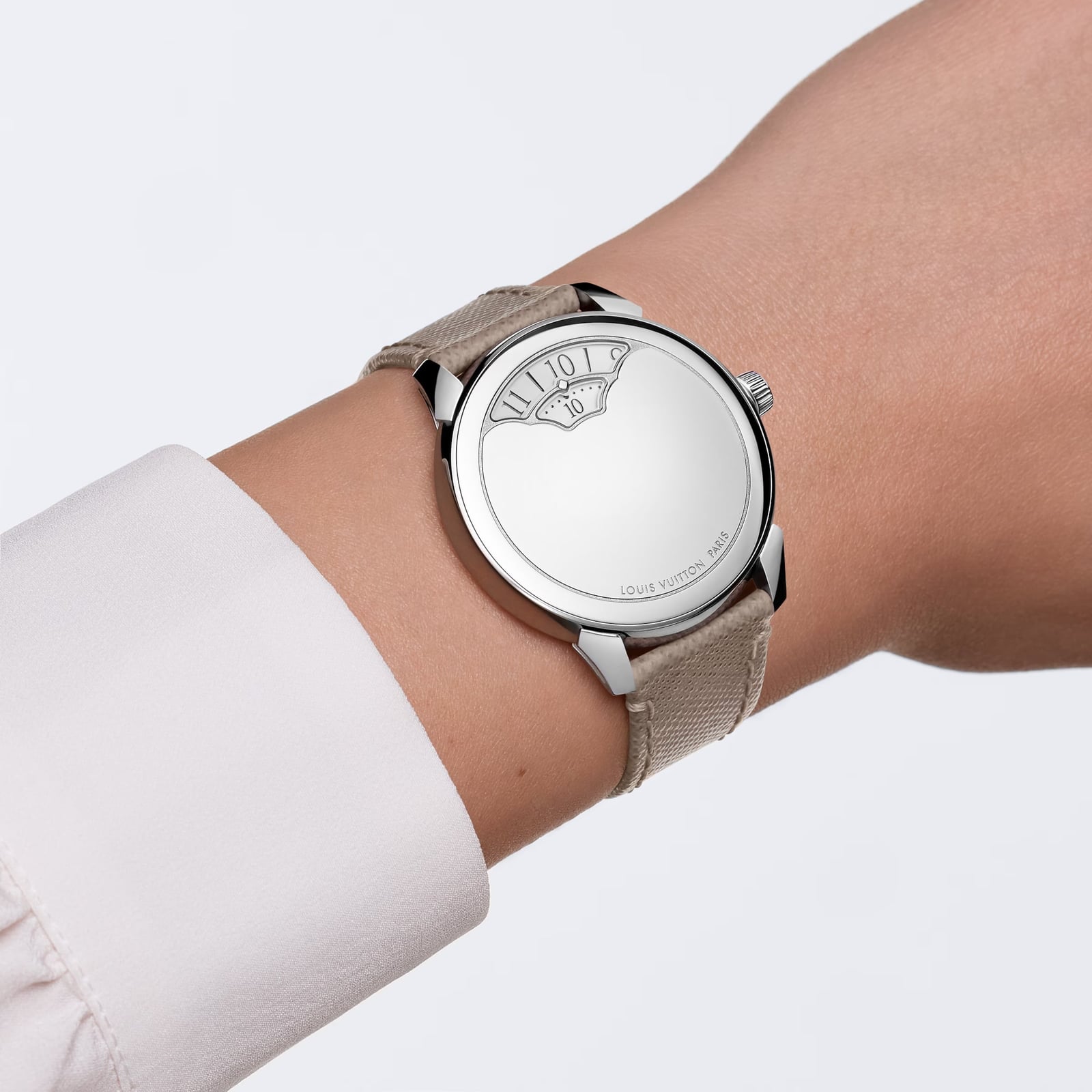
The guichet is what gives the Tambour Convergence its character. Hours and minutes appear as dragging indications on rotating discs, seen through an arched aperture with scalloped edges. Between the discs sits a sculpted lozenge that anchors the eye, a nod to the classic montre à guichet. The window’s shape recalls interior architecture at the Louis Vuitton Family Home in Asnières, which is a nice piece of heritage to carry on the wrist.
The discs are hand satin-brushed, rhodium-plated brass with black transfer-printed numerals and indexes. It is a cool, monochrome dial, and it leaves the case to do the talking.
On the wrist and under the hood
The case measures 37mm across and 8mm thick. Louis Vuitton designed that size for versatility, with a tapered crown and lugs that hug the wrist. The crystal is anti-reflective sapphire, the caseback is open, and water resistance is 30 metres. The strap is grey saffiano calf with beige calf lining, closed with a strengthened steel pin buckle engraved LOUIS VUITTON.
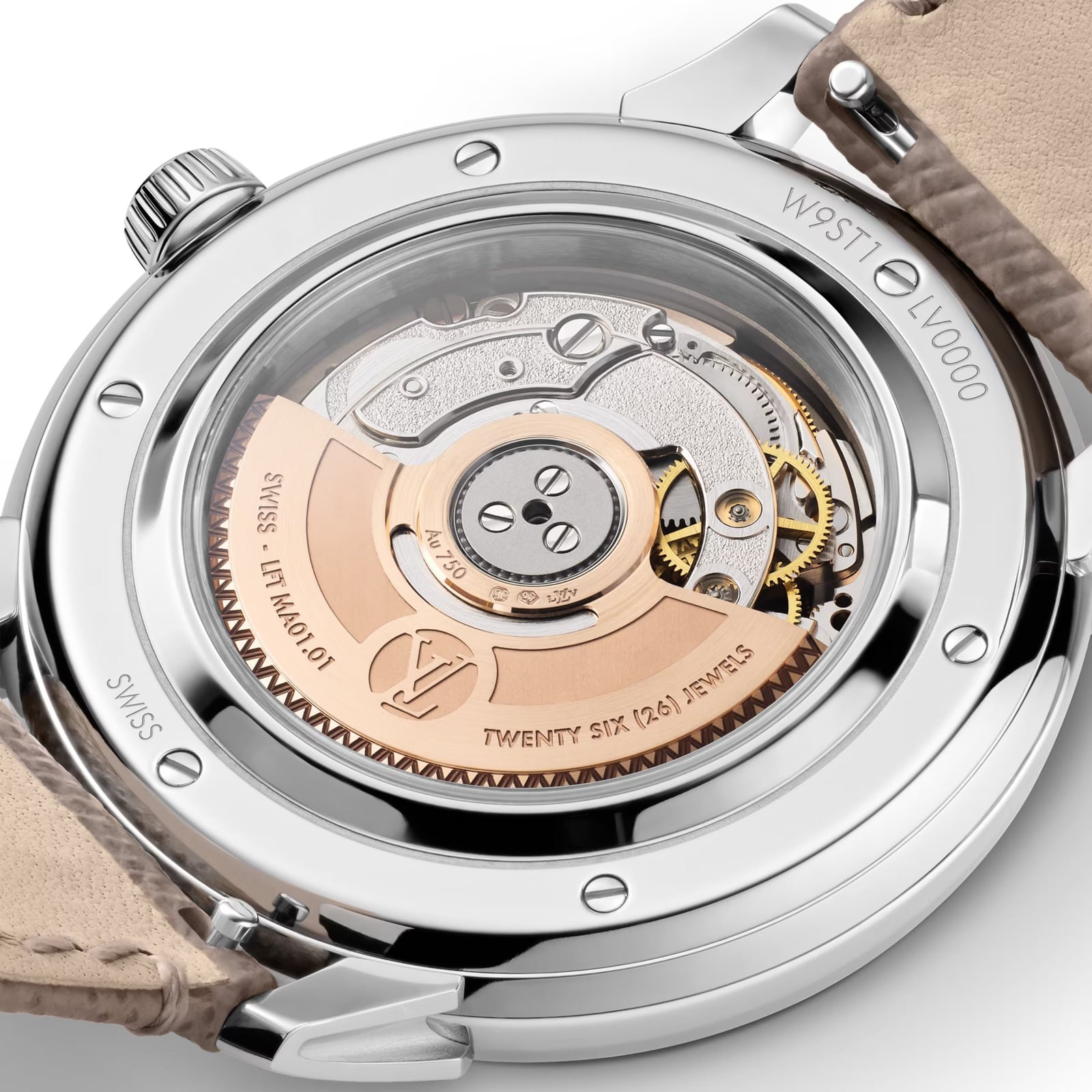
Inside is the self-winding caliber LFT MA01.01. Louis Vuitton calls it the first time-only automatic manufacture movement conceived and produced entirely at La Fabrique du Temps. It beats at 4 Hz (28,800 vibrations per hour) and uses a free-sprung balance with variable inertia. It holds a 45-hour power reserve and is made of 201 components, discs included, plus six jewels. Through the caseback, an 18k pink gold oscillating weight adds a warm note against all that cool steel.
Haute Time’s view is that this may be the most wearable Tambour Convergence so far. The reasoning holds up. Steel is the metal people wear to the office, at the weekend and everywhere in between. Louis Vuitton has taken a material usually reserved for tool watches and given it the finish of a jewel, without asking the wearer to baby it.
Via Haute Time