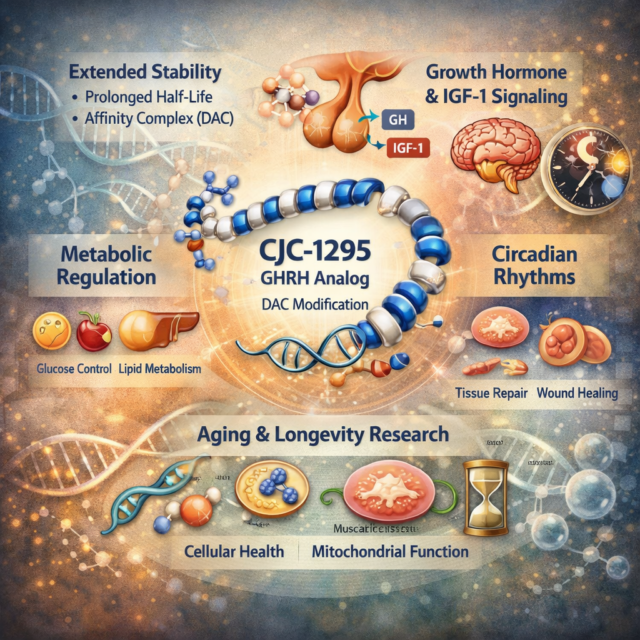
Peptide-based research has expanded considerably over the last two decades, with synthetic analogs drawing interest for their potential regulatory roles within molecular and physiological systems. Among these, CJC-1295, a tetrasubstituted peptide analog derived from growth hormone–releasing hormone (GHRH), has attracted attention for its potential to interact with cellular receptors and possibly support multiple biological pathways. The peptide was originally engineered with an Affinity Complex (DAC) modification to support its stability and extend its half-life in research models, making it a distinct candidate compared to earlier short-lived GHRH fragments.
Rather than focusing solely on growth-related signaling, speculation surrounding CJC-1295 has expanded into broader research domains, including metabolism, cellular repair, circadian rhythms, and even cellular age-related processes. Investigations purport that the peptide may initiate cascades beyond traditional growth hormone dynamics, potentially interfacing with endocrine, metabolic, and structural frameworks in ways that remain only partially understood.
Structural Considerations and Molecular Stability
One of the defining properties of CJC-1295 lies in its engineered resistance to rapid degradation. Native GHRH sequences are known to undergo swift enzymatic cleavage, limiting their longevity within experimental conditions. CJC-1295 is believed to incorporate strategic substitutions and a lysine-based reactive group that may allow covalent binding to circulating proteins, increasing its presence in research environments.
Research indicates that this molecular stability may provide prolonged receptor engagement, opening avenues for sustained signaling cascades compared to shorter GHRH fragments. Such a feature suggests that the peptide might serve as a valuable probe in experiments where extended receptor stimulation is necessary to observe downstream genomic and proteomic responses. This stability has been theorized to permit more detailed mapping of growth hormone–related pathways, particularly those that unfold over longer experimental durations.
Endocrine Axis Exploration
The most immediate domain in which CJC-1295 has been studied is its putative interaction with the hypothalamic–pituitary axis. Studies suggest that by binding to GHRH receptors, the peptide may stimulate pulsatile growth hormone release in research models, potentially altering downstream levels of insulin-like growth factor 1 (IGF-1). Such signaling is central not only to somatic growth but also to metabolic regulation, protein synthesis, and tissue homeostasis.
Investigations purport that the peptide’s support for growth hormone dynamics might provide a framework for exploring how sustained endocrine activation supports cellular proliferation and differentiation. Beyond direct growth-related processes, the modulation of IGF-1 pathways may also be examined in connection with glucose handling, lipid metabolism, and mitochondrial function. This opens a conceptual pathway for using CJC-1295 in research seeking to understand the crosstalk between endocrine rhythms and systemic physiology.
Metabolic Properties and Energy Balance
Research indicates that CJC-1295 may alter parameters associated with energy expenditure and nutrient partitioning. Growth hormone signaling has long been linked to shifts in carbohydrate and lipid metabolism, and the peptide’s sustained activity might allow for more nuanced investigation of these relationships.
For example, it has been hypothesized that prolonged receptor activity may support hepatic glucose output, muscle glycogen storage, or lipid mobilization in adipose tissue. In research models, such supports may help dissect how endocrine peptides integrate with metabolic homeostasis. Furthermore, the interaction between CJC-1295 and IGF-1 pathways might be explored in the context of mitochondrial biogenesis, suggesting possible research avenues in energy dynamics and cellular respiration.
Cellular Regeneration and Repair Pathways Research
CJC-1295 has also been speculated to contribute to investigations into cellular regeneration and structural maintenance. Growth hormone and IGF-1 signaling are both known to interact with fibroblasts, myocytes, and osteoblasts, potentially modulating extracellular matrix synthesis and cellular proliferation.
It has been theorized that sustained endocrine signaling through peptides like CJC-1295 might support regenerative dynamics by providing a prolonged window for receptor activation. This may be relevant in exploring wound healing, connective tissue remodeling, and cartilage homeostasis in controlled research environments. Moreover, the peptide’s potential to sustain signaling might permit researchers to compare short bursts of receptor activation with long-duration exposure, highlighting differences in transcriptional and translational profiles.
Neurological and Cognitive Research Potential
Though not as extensively investigated, the potential link between growth hormone dynamics and neural function has sparked speculative interest. Research indicates that growth hormone and IGF-1 signaling may interact with neurogenesis, synaptic plasticity, and myelination processes.
It has been hypothesized that CJC-1295, by sustaining these signaling cascades, may provide a unique research avenue into how prolonged endocrine stimulation interfaces with neural tissue. Speculation extends to circadian biology, as growth hormone release is typically pulsatile and tied to sleep-wake cycles. Research indicates that the peptide might thus be leveraged to examine how altering the timing or amplitude of growth hormone rhythms may support neural plasticity, memory consolidation, or even mood-related biochemical markers in research settings.
Circadian Rhythms and Endocrine Synchronization
Endocrine signaling is deeply intertwined with circadian regulation. Pulsatile growth hormone release is often most pronounced during slow-wave sleep, linking metabolic and regenerative pathways to rest cycles. CJC-1295’s prolonged activity may allow for experimentation into how altered rhythms of growth hormone secretion may support circadian biology.
Investigations purport that the peptide may be valuable in exploring whether changes in endocrine timing affect the synchronization of other hormonal cycles, such as cortisol, melatonin, or thyroid hormones. Such research may shed light on the broader orchestration of the endocrine system and its relationship with environmental cues such as light exposure, feeding patterns, and sleep architecture.
Cellular Aging and Longevity Research
Another speculative domain involves cellular aging biology. Growth hormone and IGF-1 have long been implicated in cellular age-associated processes, supporting tissue integrity, protein turnover, and oxidative stress pathways. Research indicates that modulating these signals may alter markers of cellular senescence, DNA repair, and mitochondrial function.
CJC-1295, with its extended signaling properties, might therefore be relevant to probes into the hypothesis that prolonged endocrine activation supports cellular aging trajectories. Some theories propose that the peptide may alter transcriptional networks tied to cellular resilience, while others suggest its activity may shift the balance between anabolic and catabolic processes within organisms. Although definitive conclusions remain elusive, the peptide offers a conceptual framework for testing cellular age-related hypotheses.
Conclusion
CJC-1295 stands out among synthetic peptides due to its extended stability and unique receptor engagement profile. Originally engineered as a modified GHRH analog, it has grown into a research tool with speculative implications ranging from metabolism and tissue regeneration to circadian biology and cellular aging science. Research indicates that the peptide may sustain endocrine activation in ways that permit detailed investigation of downstream processes, while also raising theoretical questions about the broader role of endocrine rhythms in cellular function. Visit https://biotechpeptides.com/ for more useful peptide data and the best research compounds.
References
[i] Sackmann-Sala, L., Ding, J., Frohman, L. A., & Kopchick, J. J. (2009). Activation of the GH/IGF-1 axis by CJC-1295, a long-acting GHRH analog, results in serum protein profile changes in normal adult subjects. Growth Hormone & IGF Research, 19(6), 471–477. https://doi.org/10.1016/j.ghir.2009.03.001
[ii] Ashpole, N. M., & others. (2014). Growth hormone, insulin-like growth factor-1, and the aging brain. Ageing Research Reviews, 15, 71-77.
[iii] Junnila, R. K., List, E. O., Berryman, D. E., Murrey, J. W., & Kopchick, J. J. (2013). The GH/IGF-1 axis in ageing and longevity. Nature Reviews Endocrinology, 9(6), 366–376. https://doi.org/10.1038/nrendo.2013.67
[iv] Poudel, S. B., Tsilioni, I., & Theoharides, T. C. (2020). Effects of GH/IGF on the aging mitochondria. Cells, 9(6), 1384. https://doi.org/10.3390/cells9061384
[v] Fernández-Garza, L. E., Salazar-Roa, M., Cervantes-Salazar, M. S., & Martínez-Estrada, F. (2025). Growth hormone and aging: a clinical review. Frontiers in Aging, 6, Article 1549453. https://doi.org/10.3389/fragi.2025.1549453
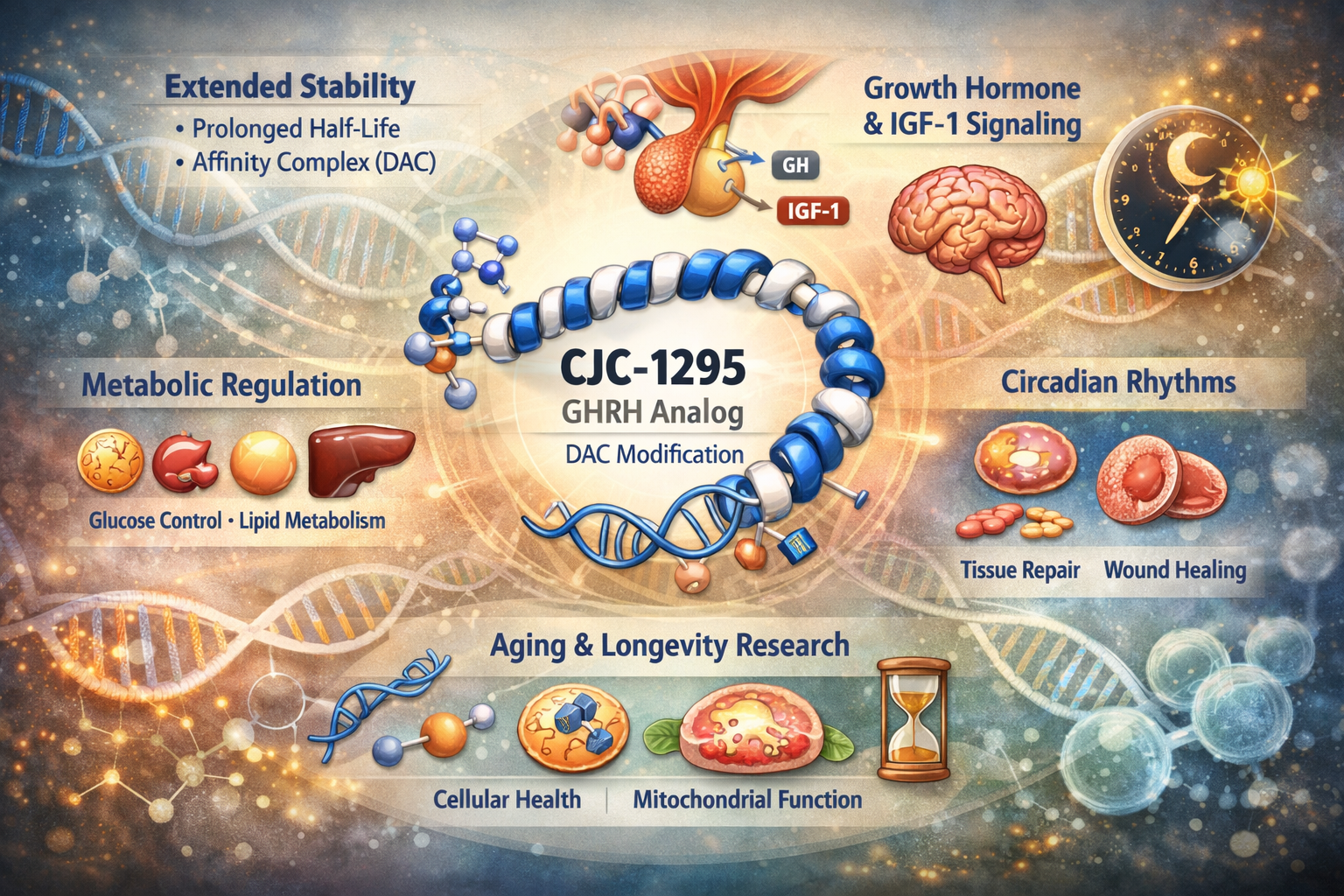
This article and accompanying illustration are provided for informational and educational purposes only and do not constitute medical, scientific, or professional advice. The content is not intended to diagnose, treat, cure, or prevent any disease. Readers should not interpret the information as a recommendation for use of any substance or protocol. Always consult qualified medical professionals, licensed healthcare providers, or relevant specialists before making any health-related decisions or engaging in research activities.