Front Row
Lamborghini Drops the Roof on the Temerario, and Lets the V8 Shout
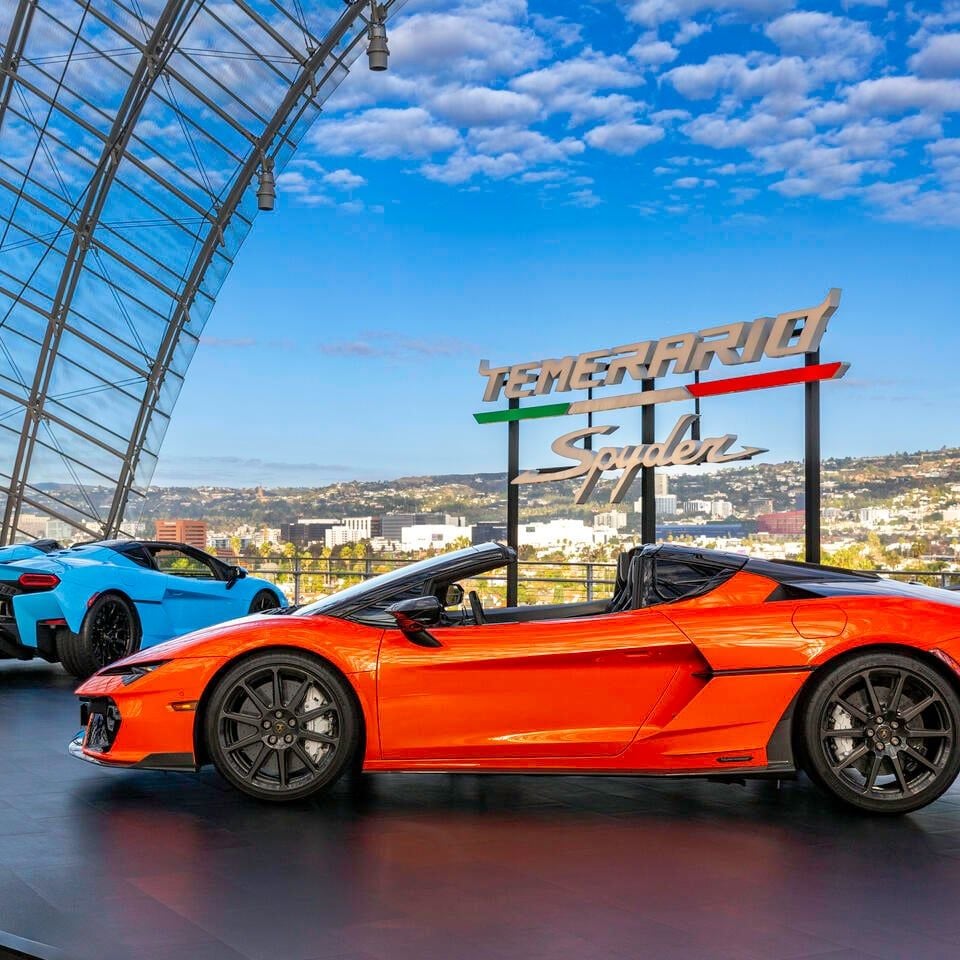
The Temerario Spyder brings Lamborghini's first retractable hard top, 920 CV of hybrid power and a flat-plane V8 that revs to 10,000 rpm. Open-air driving, fifty years on.
The Lamborghini Temerario Spyder has a roof that folds away behind the seats on ten electric actuators, and it is the first Lamborghini Spyder ever to have a hard top that does so. The car was unveiled on 19 November in Sant’Agata Bolognese and Los Angeles, and it carries the same hybrid V8 as the coupé: 920 CV, with a limit of 10,000 rpm.
A roof that stays out of the way
Packaging a hard top on a mid-engined supercar usually costs you something in looks, weight or balance. Lamborghini’s engineers went for a patented vertical stowed position. The panel stands upright behind the seats, and the ten electric actuators replace the traditional electro-hydraulic circuitry. With the roof down, the centre of gravity sits 3 mm lower than with it closed. Weight distribution doesn’t change.
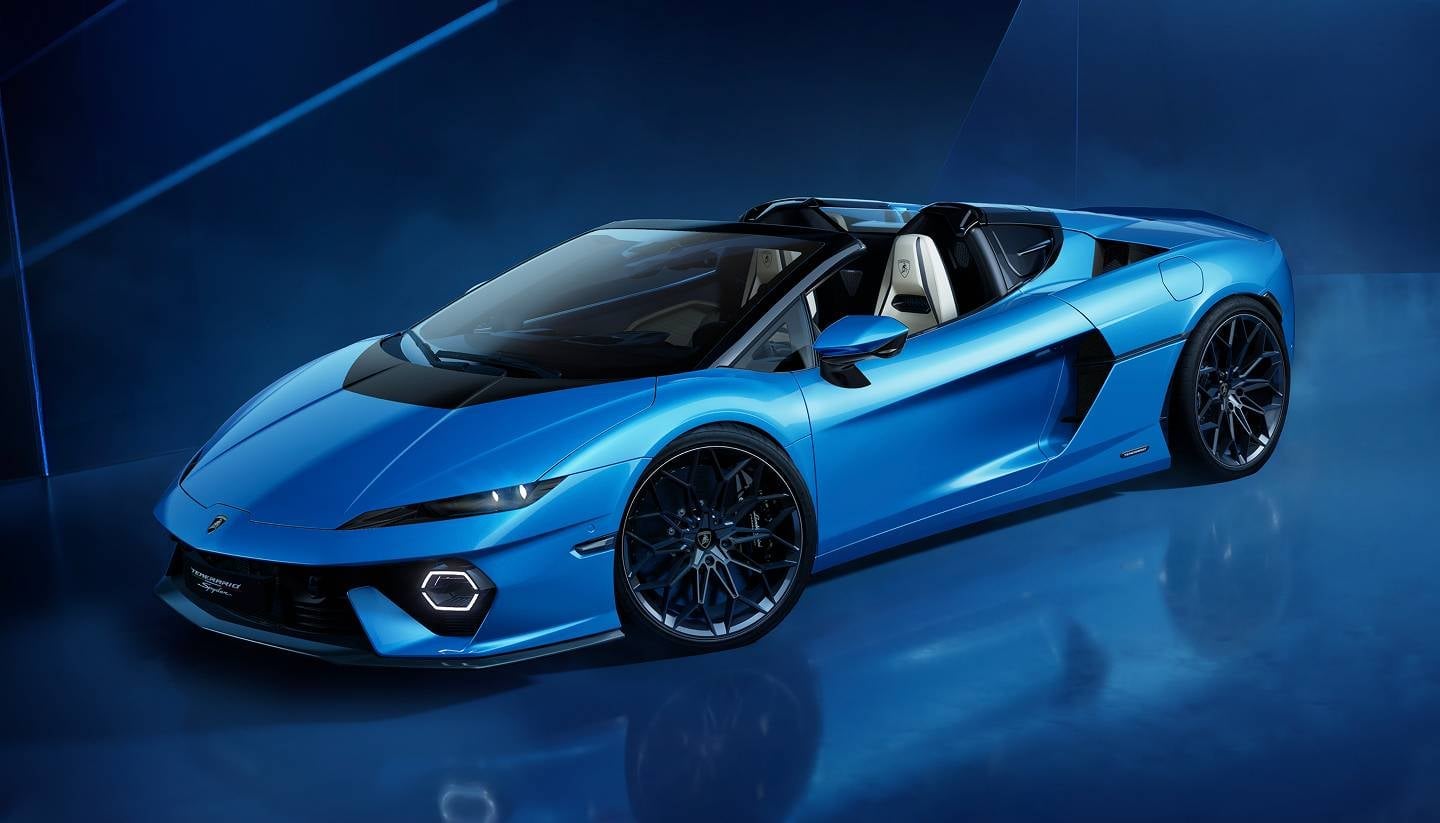
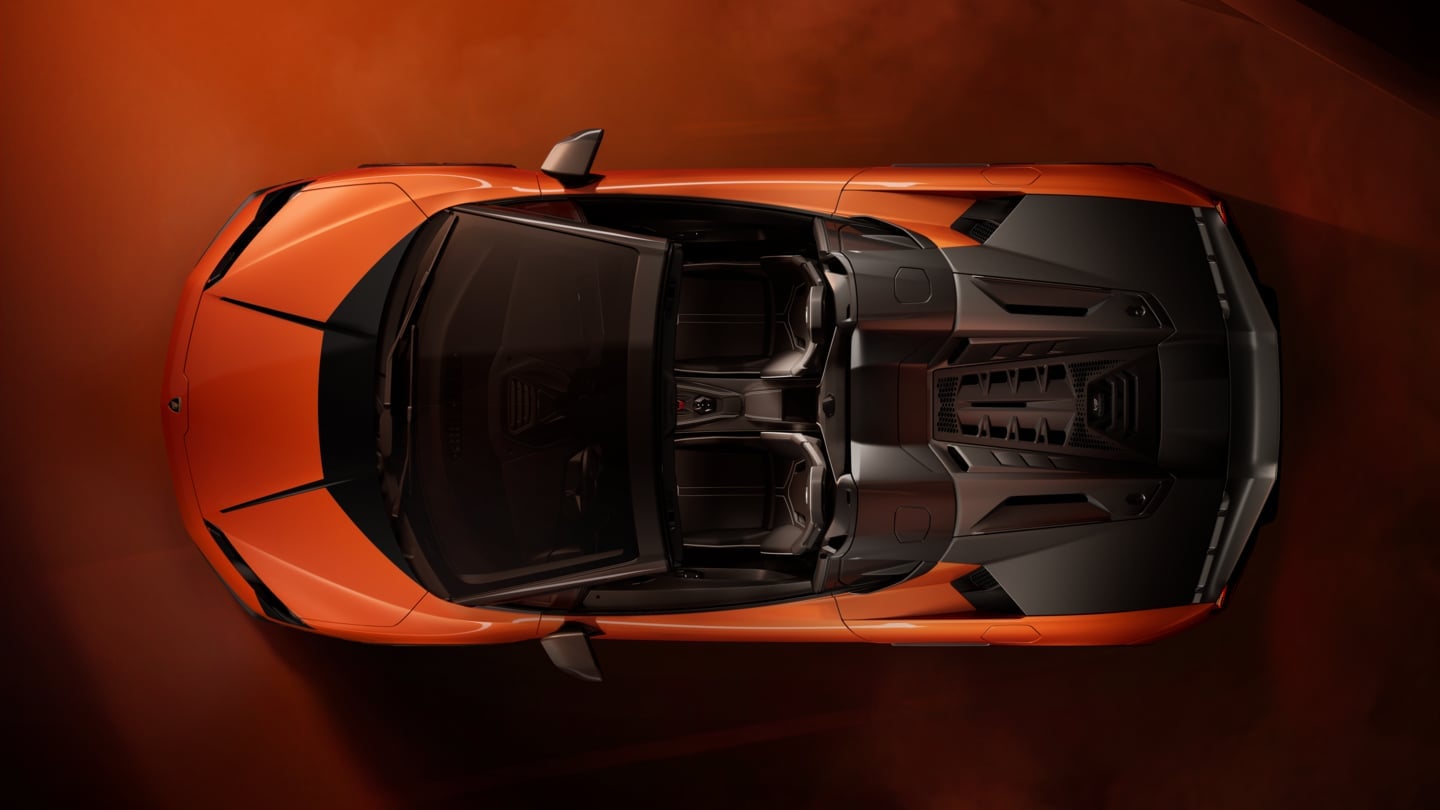
Design Director Mitja Borkert says the team “did not simply want to take the roof off the coupé.” The hardest part, in his words, was integrating a complex system “without turning it into an add-on.” The result is a low, continuous silhouette. Two hexagonal cowls sit behind the seats and run the line of the cabin toward the tail. They also frame the engine cover, and Borkert says the V8 was meant to stay visible because “mechanics are part of the aesthetic experience of a Lamborghini.”
There’s a smaller trick at the back. An electronically adjustable rear window lets driver and passenger decide how much air and how much engine comes into the cabin.
What’s under the cover
The Spyder uses Lamborghini’s HPEV architecture: a 4.0-litre twin-turbo V8 working with three axial-flux electric motors, one at the rear and two on the front axle. Combined output is 920 CV (677 kW) and 800 Nm. The V8 alone makes 800 CV (588 kW) and revs to 10,000 rpm, rising to 10,250 with Launch Control engaged. The engine has a 180° flat-plane crankshaft, titanium connecting rods and DLC-coated finger followers. Its turbochargers run up to 2.5 bar of boost.
The figures: 0 to 100 km/h in 2.8 seconds, 0 to 200 km/h in 7.3 seconds, and a top speed of 343 km/h.
The car’s character is adjustable. Thirteen driving experiences come from pairing five modes (Città, Strada, Sport, Corsa and Corsa ESC Off) with three strategies: Recharge, Hybrid and Performance. In Città the Spyder can run on electric power alone, up to 190 CV (140 kW). At the other end, a three-level Drift Mode manages controlled oversteer.
How it should sound
For a convertible, the exhaust note is a large part of the appeal, and Lamborghini has said what to expect. The flat-plane V8’s voice is built around a prominent fourth-order harmonic, with a crescendo that carries up to 10,000 rpm. Vibrations travel through the spaceframe and seats, so you feel the engine as well as hear it. The rear window changes how much of it reaches you in each driving mode.
Buyers who want more can add the optional Akrapovič titanium exhaust. It weighs 11.40 kg, which is 12% less than the standard system, and it has black tailpipes. Lamborghini published a separate story on it earlier in November. Anyone who would rather have a soundtrack of their own choosing can specify a 750 W, seven-speaker Sonus faber system.
Stiffer, roomier, and still a bit pampering
The all-aluminium spaceframe is 6% stiffer in static torsion than the Huracán Spyder’s. Dynamic bending stiffness is up 9% and dynamic torsional rigidity up 6%. Lamborghini also cut structural components by 50% and heat-input welds by 80% against the Huracán EVO Spyder.
The cabin is bigger as well. Compared with the Huracán EVO Spyder, legroom is up 46 mm, headroom 22 mm, and shoulder and elbow room 9 mm. The car is designed to fit occupants up to two metres tall. Aerodynamic work around the windscreen cross-member and rear roof elements is meant to keep turbulence in the cabin down. Suspension tuning cuts secondary vibrations on uneven surfaces by 20%. A three-level seat neck warmer is available for cooler drives, and the 112-litre front luggage compartment should handle a weekend bag or two.
Stopping comes from CCB Plus carbon-ceramic brakes: 410 x 38 mm discs with 10-piston calipers at the front, 390 x 32 mm discs with 4-piston calipers at the rear. Bespoke Bridgestone tyres come in 20- and 21-inch sizes, including Potenza Sport, run-flat Potenza Sport RFT, Potenza Race and Blizzak 6 winter options.
Colour, and fifty years of open air
The Ad Personam programme has around 400 exterior shades. Harlequin finishes include Blu Hal, Verde Agave, Oro Alba and Celeste Kami. There are Italian Tricolore liveries, custom Start & Stop flap colours, illuminated door sills and personalised carbon-fibre interior plaques.
Chairman and CEO Stephan Winkelmann describes the car as offering “two different experiences of the same car, with no compromise in emotion, technology or driving pleasure.” The timing suits the brand. The debut marks fifty years of open-top series-production Lamborghinis, a line that began in 1976 with the Silhouette and continued through the Jalpa, Diablo Roadster, Gallardo Spyder and Huracán Spyder. The Temerario Spyder is the newest in that run, and the first with a hard top that disappears behind the seats.